

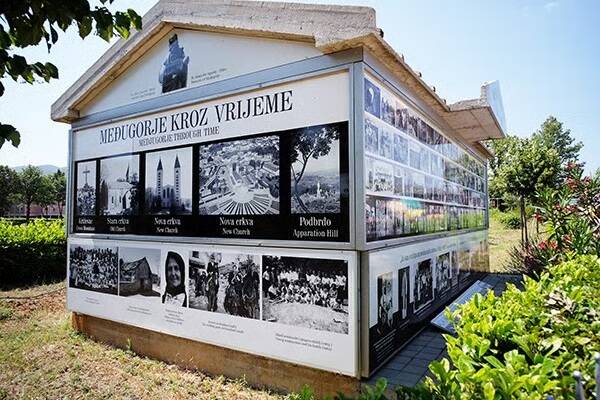
Pictorial History of Medjugorje Located Near Father Slavko Grave
Medjugorje ---- General Information
The Parish of Medjugorje
Medjugorje is the largest village within the Roman Catholic Parish of Medjugorje, located in the southwestern region of Bosnia and Herzegovina. The parish includes the surrounding villages of Bijakovići, Miletina, Vionica and Šurmanci.
The name Medjugorje is of Slavic origin and means "the area between two hills."
The region enjoys a mild Mediterranean climate, with an average annual temperature of approximately 14°C. The parish has a population of about 5,000 people, predominantly of Croatian origin. Croatian is the principal language spoken, and the community is deeply rooted in the Roman Catholic faith.
The pastoral care of the parish is entrusted to the Franciscan priests of the Herzegovina Franciscan Province of the Assumption of Mary.
Life Before the Apparitions
Until June 24, 1981, Medjugorje was a quiet agricultural village, much like many others in the region. Families worked their land, cultivated tobacco and vineyards, produced wine, and grew vegetables. Life was simple, and people worked hard to provide a modest living for their families.
A Parish Transformed in 1981
Everything changed on June 24, 1981, when the reported apparitions of Our Lady began.
From that moment, Medjugorje became known throughout the world as a place of prayer, conversion and pilgrimage.
Our Lady's choice extended beyond the six visionaries. She also called upon the entire parish community, together with the many pilgrims who would come from around the world, to become part of her mission.
This special relationship with the parish was expressed in a message attributed to Our Lady on March 1, 1984:
"I have chosen this parish in a special way and I wish to lead it."
Today, Medjugorje welcomes pilgrims from every corner of the world, all drawn by a desire to deepen their faith, experience prayer and discover the spiritual message of Our Lady.
The History of Medjugorje
The history of Medjugorje dates back to Roman times, but the village became known throughout the world following the reported apparitions of the Blessed Virgin Mary in 1981.
The Catholic parish of St. James (Sveti Jakov) was established in 1892 by the Bishop of Mostar, Paškal Buconjić. In 1934, a magnificent twelve-metre concrete cross was erected on Mount Križevac (Cross Mountain), completing the parish's Stations of the Cross. Today, Križevac remains an important place of prayer and reflection for pilgrims from around the world.
On June 24, 1981, six young people from the village of Medjugorje reported seeing the Blessed Virgin Mary. Since that day, Medjugorje has become an internationally recognized destination for Catholics seeking prayer, peace and spiritual renewal.
Through the messages attributed to Our Lady, the world is reminded of God's love and the importance of returning to Him. Her message is simple yet profound: God is the fullness of life, and true peace and happiness can only be found by placing Him at the centre of our lives.
Our Lady's mission is one of peace, love and conversion. She continually points us toward her Son, Jesus Christ, encouraging us to strengthen our faith, rediscover the importance of prayer and open our hearts to God's grace.
Six people, known as the visionaries, reported experiencing these apparitions: Ivan, Jakov, Marija, Mirjana, Vicka and Ivanka. Their experiences have inspired millions of people around the world to deepen their relationship with God and renew their commitment to their Catholic faith.
Today, Medjugorje welcomes pilgrims from every corner of the world. For many, a visit is much more than a journey to a special place. It is an opportunity to step away from the distractions of everyday life, experience the beauty of prayer, and return home with a renewed sense of faith, hope and peace.
Medjugorje is a place where hearts are touched, faith is renewed, and people are encouraged to draw closer to God.